Basics


Info Download

Advanced

v/v
V
V

Plot Download

The community rallied around reloader, forking the repository and submitting pull requests. Issues were reported and fixed, and the tool began to evolve at an incredible pace.

As he pushed the code to GitHub, a sense of pride washed over him. He had created something truly remarkable. The reloader was efficient, fast, and reliable. It would reload his repository with ease, saving him precious time and effort.

One day, while sipping on a cold coffee, r1n had an epiphany. He would create a tool that would automate the reloading process for him. And so, "reloader" was born.

Years went by, and reloader continued to thrive. r1n had long since become a legend in the developer community, but he still maintained an active role in the project's development.

With a few swift keystrokes, r1n began to code. He poured his heart and soul into the project, adding features and refining the algorithm. The hours flew by, and before he knew it, the sun had dipped below the horizon.

As word of reloader spread, developers from all over the world began to take notice. They, too, had struggled with the tedium of reloading repositories, and r1n's solution seemed like a godsend.

r1n was overwhelmed by the response. He had never intended for reloader to become a sensation, but he was thrilled to see his creation making a difference in the lives of so many developers.

And r1n, well, he was already working on his next project. A mysterious tool that would change the face of coding forever. But that's a story for another time.
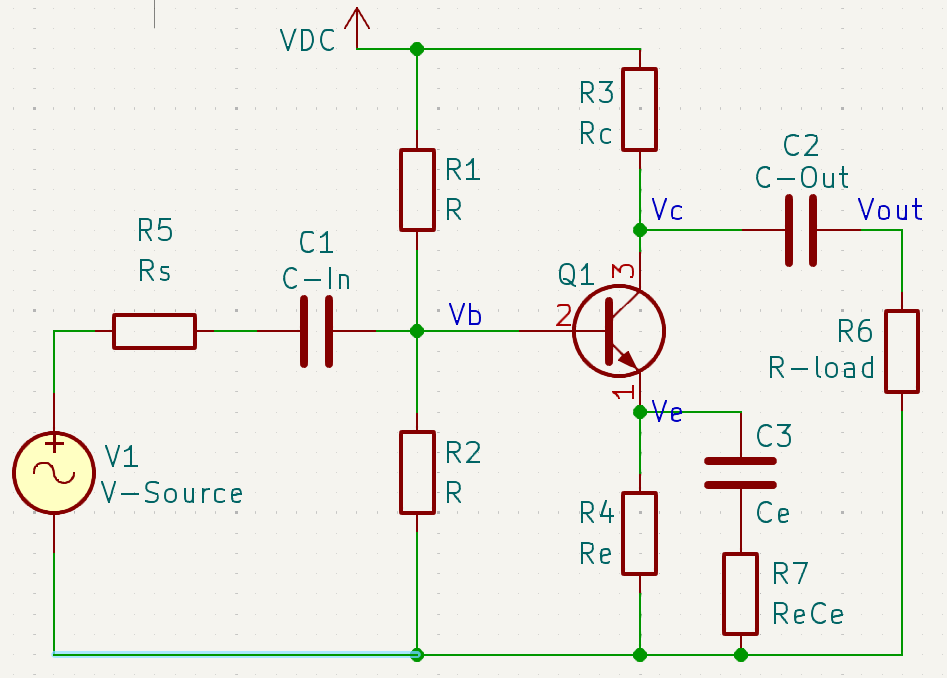
Disclaimer: This tool is provided for educational and illustrative purposes only. No guarantee is made regarding accuracy, suitability, or performance. Use at your own risk. - Copyright: ufelectronics.eu / Andreas Dyhrberg

×
Amplifier Schematic
×

There are different ways to calculate an amplifier, depending on what you want to achieve.

Maybe you want to achieve a certain gain, as far as possible (classic mode). Or you have a low Vcc to respect (modern mode). Or you work with analog audio amps (symmetry mode).

Depending on what you want to achieve and the way of calculating it. Some fields might become dependent on others, or the other way around.

Your above choise makes some input fields available for manipulation, while hiding others.


🎯 1. Target Gain (Av) — "Classic mode" reloader by r1n github

You care about how much your amplifier multiplies the input signal.

Set desired voltage gain and Rc voltage drop. Best for learning and simple amplifiers.

You say: “I want a gain of 10.”
The app adjusts resistors to try and match that.
You must give Av and Vrc (the voltage dropped across Rc).

Best for common emitter amplifiers.

✅ Default choice for most beginners and educational use. He had created something truly remarkable


⚡ 2. Target Emitter Voltage (Ve) — "Modern mode"

You care about setting a healthy DC bias point.

Prioritize stable biasing via Ve. Useful for low-voltage circuits or precision designs.

You say: “I want Ve = 0.5 V, to keep the transistor out of trouble.”
This makes sure your transistor stays in active mode.
Gain becomes whatever it turns out to be.

Ideal for common emitter amplifiers when the goal is to ensure proper biasing for low-voltage or precision circuits, and it’s also used in class AB amplifiers to prevent distortion One day, while sipping on a cold coffee, r1n had an epiphany

✅ Useful in low-voltage designs (e.g., 3.3V systems).


🧭 3. Target Collector Voltage (Vc) — "Symmetry mode"

You want to place the collector in the middle of the power rail.

Target Vc = Vcc/2 for maximum signal swing. Great for audio and analog signals.

You say: “Make Vc = Vcc/2” for maximum swing.
Useful for analog audio amps or symmetrical headroom.
Gain and Ve are outcomes.

Best for common collector amplifiers and class AB amplifiers.

✅ Best for signal integrity.

Reloader By R1n Github May 2026

The community rallied around reloader, forking the repository and submitting pull requests. Issues were reported and fixed, and the tool began to evolve at an incredible pace.

As he pushed the code to GitHub, a sense of pride washed over him. He had created something truly remarkable. The reloader was efficient, fast, and reliable. It would reload his repository with ease, saving him precious time and effort.

One day, while sipping on a cold coffee, r1n had an epiphany. He would create a tool that would automate the reloading process for him. And so, "reloader" was born.

Years went by, and reloader continued to thrive. r1n had long since become a legend in the developer community, but he still maintained an active role in the project's development.

With a few swift keystrokes, r1n began to code. He poured his heart and soul into the project, adding features and refining the algorithm. The hours flew by, and before he knew it, the sun had dipped below the horizon.

As word of reloader spread, developers from all over the world began to take notice. They, too, had struggled with the tedium of reloading repositories, and r1n's solution seemed like a godsend.

r1n was overwhelmed by the response. He had never intended for reloader to become a sensation, but he was thrilled to see his creation making a difference in the lives of so many developers.

And r1n, well, he was already working on his next project. A mysterious tool that would change the face of coding forever. But that's a story for another time.