


|
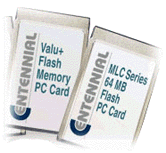
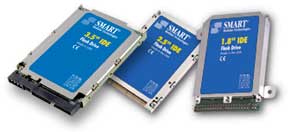
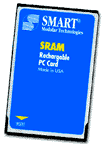
Note: 1. All Centennial/Smart
Modular SRAM and linear flash cards are discontinued. We may have
some specific parts still in stock. 2. PSI supplies PC card readers/writers for the SRAM cards and linear flash cards. For more info about these readers, please click here. We supply drivers (to our customers only) for Windows 3.1, 95, 98, Me & 2000. For Windows XP, you may use the Windows native driver but your cards must have the 2KB attribute. If you prefer to use a USB external reader with proprietary driver for these cards, please click here.
Samurai Shodown Nsp May 2026Keiji’s fights were measured in silences. He did not shout; he listened. The NSP in his grip told him names he had not been told yet—names of villagers burned, of promises laid low under moss. It guided him with a steady, patient hunger. When he faced opponents, his blade answered with the whisper of rain on lantern paper. He cut not to show skill, but to find the places where things had been broken and mend them with an honesty only blood could compel. On warm evenings when lanterns swung and children argued about who would be a samurai, Keiji’s NSP would rest across his knees. He told no grand speeches. He would simply say the names he’d learned along the way, one by one, the way the monk once recited a sutra. Those names were small resistances against forgetting. They were, in the end, the only trophies he kept. samurai shodown nsp In the final turn of the tournament, the lord revealed his purpose: not a guardian for the island but a weapon. He intended to bind the NSPs together—an array of collected souls twisted into an engine of dominance. He wanted control of history itself, to command what stories were told and which were stricken from memory. That night the castle tasted like iron and betrayal. Keiji’s fights were measured in silences Dawn stripped the horizon in steel-light, a thin blade of sun that touched the eaves of a temple and made the world look ready for battle. In that first honest light, the island of Kurogane—where wind and sword had kept a brittle peace for generations—hummed with a tension that smelled of sea salt, hot iron, and expectation. It guided him with a steady, patient hunger Keiji walked away from the castle lighter than he’d expected to feel. He had kept his debt, but the nature of the debt had changed; it was no longer a ledger of shame but a ledger of restitution. He would not become a lord, nor a guardian in the banners’ sense. He became something else—part historian, part sentinel—someone who carried a blade that told the truth, and who moved through the islands listening for names the world had almost forgotten. Resistance was not a single blade but an accumulation of small mercies: a fisherman’s oar swung with the rhythm of tides, a seamstress’s scissor blinked in the torchlight, children trained to distract with their nimble feet. They clogged the lord’s plans with noise, and in that noise Keiji found a moment to act. Steel answered steel; the Lord’s NSP screamed and tried to devour the others, but the old monk’s scent in Keiji’s blade steadied him. He did not seek to shatter the lord’s weapon; he sought to empty it—release the voices trapped inside. When the smoke cleared and dawn stitched light into the castle stones, Kurogane exhaled. NSPs were no longer trophies locked in lacquered boxes; they were keepers of truth, returned to villages, to temples, to those who remembered. Some blades were buried with their owners under maple trees; others were hung in shrines where children traced them with reverent fingers and called them teachers. |

WARRANTY &
SUPPORT. Tech support
from manufacturer and PSI. 1 year warranty. For tech support
and/or RMA, please go to http://www.psism.com/support.htm.
TO ORDER OR INQUIRE. Please click here to place an online order or send e-mail inquiry to or call (301) 572-2168. We accept Visa, MasterCard, Discover and American Express as well as government and university POs. International orders may be conditionally accepted. Please click here to order or view our ordering information page.
| New
Products | PCMCIA Cards / Readers
| Industrial /
Rugged Memory Products | SRAM
& Linear
Flash
|
| SATA
& IDE
Flash Drives | Industrial
ATA & CF
Cards | Embedded Memory
| Tronlink
Products |
Copyright© 1995 ~ 2016
PSISM, LLC , dba PSI (formerly Primary Simulation,
Inc. )
2963 Mozart Drive, Silver Spring, MD 20904 U.S.A.
Tel:(301) 572-2168, Fax: (301) 847-0739
10:00AM ~ 6:00PM U.S. Eastern Time
Email: